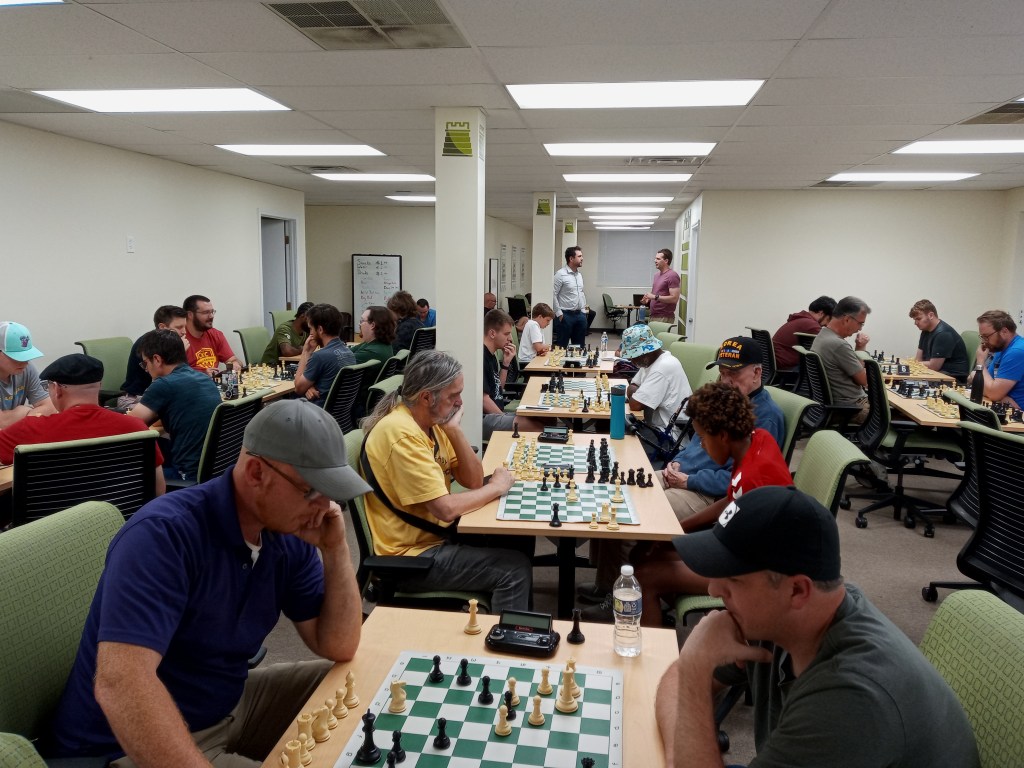
“It takes everyone 30 minutes to leave” a regular club goer said as he was working on a third 15 minute delay before heading out for the night. Successful community building is often marked by the delayed departure of people. It is wildly affirming, and a sign people are hungry for the provided opportunities Wednesday Night Chess brings.
My dream for Louisville, Kentucky is to have a thriving chess community that meets in person, regularly. I wish sharing my games online was as satisfying as an in-person back-and-forth verbal tug-of-war. Attempting to prove one another wrong is fun, especially when everyone is seeking the truth instead of trying to be right. This process, for me at least, is so much more valuable and meaningful in person.
People delay leaving WNC because they want to say goodbye to friends, they want to hear the tail end of the conversation being had, and the tail end of the next conversation that hasn’t started yet. WNC has given people social opportunities not seen elsewhere. It connects people together: dozens of friendships have been made, one member sold a condo to another member, and we have people from nearly all zip codes coming to WNC who may not have otherwise met.
Using chess as the social mortar, the community is understanding tournament play, ratings, and championships are not as important as personal growth, connections, and improvement. WNC challenges people to explore chess in a safe way, and people discover that exploring chess is a facade for facing yourself. Chess exposes your vulnerabilities, and forces self-confrontation. Internet chess forces this process to be done alone while WNC allows this process to be done with a community to lean on.
Why does chess make us feel bad?
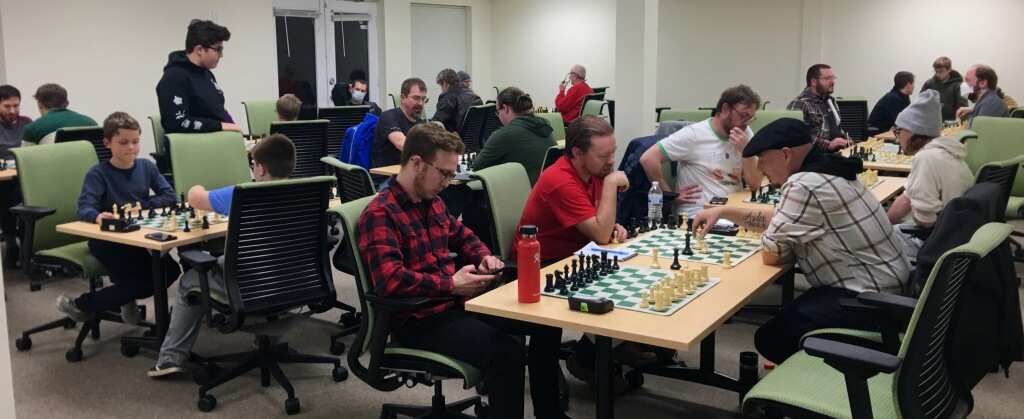
Chess can be a very isolating endeavor which can stand in the way of improvement. The isolating nature of chess can also make us feel terrible, which feeds negative thought patterns. So why does chess make us feel bad? Here is a short, but not exhaustive, list:
Reason 1 – Internet chess isolates everyone under the guise of hyperconnectivity.
Don’t believe me? Have you ever felt bad about “leaving internet chess too early?” When an online opponent says something obnoxious, do you keep that story to yourself or share it with someone in person? When you have an awesome game, is it more satisfying to share it online, or to show it to someone in person (and then look at their cool game too)?
No one disputes the value of internet chess. But it is difficult for me to agree that the “community” the big chess websites boast they build actually adds more value than in-person chess.
Reason 2 – Chess culture celebrates winners, not improvers.
Like sports, chess celebrates the winners of competitions. People often forget that titles, high ratings, and cool queen sacrifices are given meaning by the people who fail to obtain titles, cannot achieve high ratings, and never see queen sacrifices. Winners forget this fact too often.
When considering a newly crowned champion, do you ever wonder how much total negative emotion the winner’s opponents felt during that champion’s ascent? Is the total amount of negative emotion less, equal to, or more than the champion’s experienced elation? I do not mean to cheapen the winner’s experience, but we always focus on the winner’s experience: what about the loser’s experience? Is the loser’s experience not worth focusing on and is it better to constantly give advice like “Buckle down,” “You just need more grit,” or “All you have to do is keep going over your games”?
Another example is most people dislike draws because there is no winner, which feels like a watered down plot twist at the end of a riveting novel. People prefer to talk about queen sacrifices but not Quiet Moves. People like to counter “I had a good move here” with “…but you lost the game.” It is almost like people prefer to push someone down, as if gravity is on their side, rather than lift them up.
WNC celebrates improvers. One of the posters on the club’s wall says “Always Praise Progress” for a reason. WNC is about working on your chess skills, losing, analyzing your errors, and helping others do the same. WNC fights against the notion that winners are the only thing worth celebrating, because that isn’t true.
Reason 3 – Chess elitism is toxic, and it is usually ELO-centered.
A quote from a 1400 level player: “I only play higher rated players.”
A quote from a 1900 level player: “What incentive do I have to play lower rated players?”
These quotes are two sides of a toxic coin that is passed around the tournament chess community – and not just locally, but nationally, too. I have heard these quotes from many players over the years, but these phrases were stated to me within the same week shortly before I decided to do Wednesday Night Chess. These phrases were, and remain, primary motivators for the existence of Wednesday Night Chess.
Divisive phrases like these are common within the chess community, especially when it comes to women and girls in chess (and women and girls have felt more toxicity within tournament culture than anyone). WNC, open to all for free, fights against notions like this. We are intentionally not running rated games on Wednesdays and are accepting of all people who wish to arrive — as I always say, you are a member if you walk through the door. WNC ensures that people can reliably play chess and connect with people outside of tournament culture.
Like internet chess, tournaments clearly have value to the chess community. No one would argue otherwise. But there is a lot of elitism within tournament culture that turns people away from chess. Organizers are very quick to take everyone’s entry fee, thank people for coming, and are not too bothered by the fact that a large percentage of people do not return to tournament play. In fact, US Chess would literally go bankrupt if they allowed all people to play in one tournament before buying a membership: that is how high the rate is of people walking away from chess. I know this is a fact because I was on the US Chess board and saw these numbers.
Reason 4 – Tournaments can be isolating.
According to a WNC club member, the popular notion online is that the post mortem “is dead” — the post mortem is what we call the ritual of going over the game with your opponent after the game has concluded. Why is it dead or dying? “Because you don’t want to educate your opponents.” I find that sad.
There is other supporting evidence that this notion is true, however. For example, many chess tournaments are scheduled to be no longer than one day (many people no longer have the ability to play chess for 2 to 4 days). Therefore, in order to fit all the rounds in one day, rounds are ASAP instead of scheduled and the time controls are shortened. This leaves little time for players to actually have a post mortem. Thus, if the post mortem is dying, then chess players talking to one another is also becoming less common.
I would never make an argument that we should go back to multi-day events and such — most people don’t want that and who am I to dam the zeitgeist? But the result of these new organizing trends are events that minimize the time chess players have to connect, and that is something I can combat.
WNC attempts to buck this trend a bit because there are no scheduled rounds. You can play five games in a row or play one game then go over it. You and your opponent set the pace. People may join in and discuss your game, too.
Reason 5 – Chess players often feel guilty.
Did you know that the main purpose of chess books is to sit on a shelf unread for the purpose of making their owner feel guilty? It’s true!! Of course, I jest. But there is truth to this statement.
Many people want to improve and will invest time and money to do so – this often means buying books or online courses (or chess coaches). But when they cancel lessons, don’t read the books, or fail to really get anything out of the online course they bought, they feel bad. Not just bad, they often feel stupid or inadequate. Not reading a book means you only have to feel guilty, and not stupid and ashamed.
WNC looks to combat this problem by offering a book club (that around 20 people have joined). The main purpose is to help people gain the skill of reading a chess book (which is not the same experience as reading any other kind of book). We go through each chapter, look at examples, and learn. This learning format has been far more effective than my past attempts to gather adults for formal classes. For many adults, reverting back to a classroom setting comes with negative connotations, and might even feel like a step back. But the book club seems to be working well.
My Passion for Chess Teaching

Steve Dillard, a man most of the newer chess players would not know, ran chess tournaments for over 30 years at the very affordable cost of $5 (and eventually, $7). He was a decent chess player of 1800 level strength. However, his passion for chess was running tournaments. At the time of his death, he had run more chess tournaments than anyone in the country, and likely anyone in the world (but that claim is unverified and may be wrong). If a person could not afford to play, he let them play for free (and by free, I mean he would pay for their US Chess membership and their entry fee, and he wouldn’t tell them he was doing that).
Steve Dillard remains a massive influence in my life. He taught me the value of service to the chess community. The Chess Education Foundation has continued his legacy by running a weekly Monday Night Chess tournament, an event that now has a 40 year history. Most Kentucky chess players over the past 35 years have, at one point or another, competed in this weekly event.
But my passion is not running tournaments. My passion is teaching chess. For me, WNC represents my effort to give back to the community like Steve did. My goal is to help as many people improve as possible. This entire article is my shortened explanation for why I am doing WNC and why I think it is so crucial — there are a lot of negative trends within the chess community and someone needs to try to improve things. I am doing what I can and while some of this is deeply philosophical for me, it is also a lot of fun. It is one of my favorite things to do.
I don’t want anything to think I am against chess tournaments — that isn’t the case. But I am against toxic behavior that pushes people away from chess, and this behavior seems to exist primarily in tournaments and in online chess forums. You have to understand, the very core of my being says “Half of chess players walk away from tournaments feeling like losers.” No one ever talks about this crowd — the losing crowd, the crowd who champions cannot exist without, and who so very often avoid playing.
Everyone talks about winners, people who performed better than expected, and all the losers get is “better luck next time” kinds of comments. My aim with WNC is to build community, create a judgment free space for all people, and to facilitate learning in a way that is meaningful. My goal is to provide people with as much support as I can, and hope that the community buys into my dream, too.
 ryanvelezblog